SD501DX vs JRIV: Which Kangen Water Machine Is Right for You?
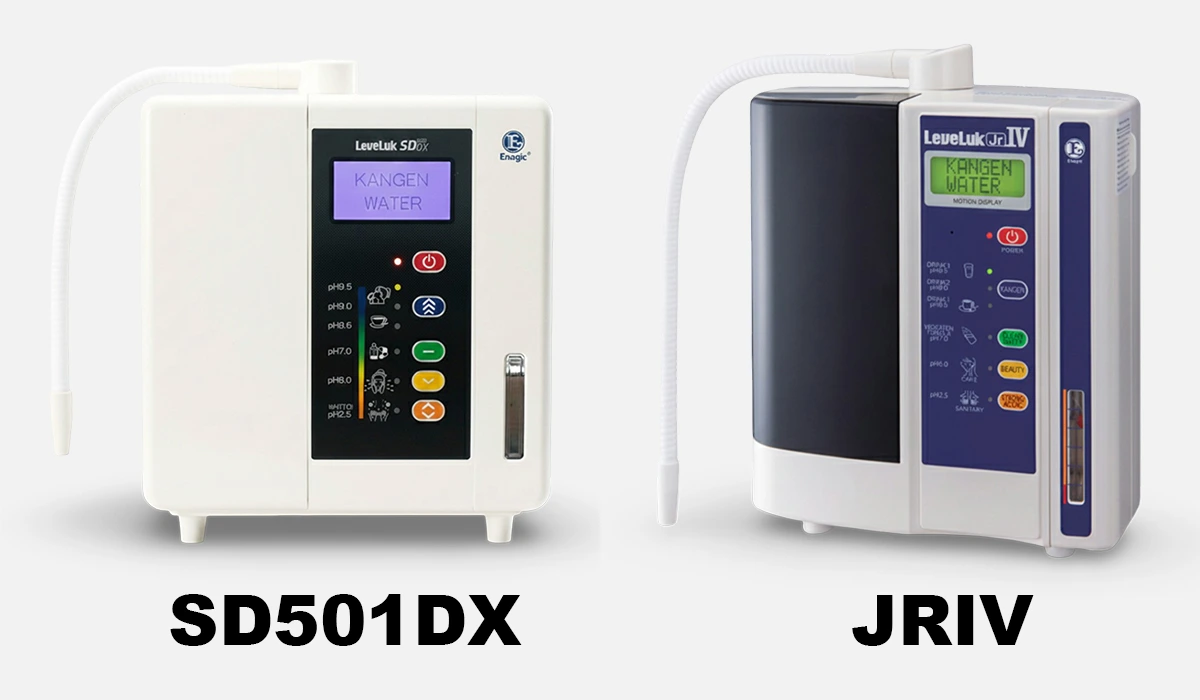
The LeveLuk SD501DX and LeveLuk JRIV are both designed for residential use, but they are positioned for different types of buyers.
The SD501DX is a regular residential model well suited to family use, while the JRIV is a budget-oriented residential option that can be particularly suitable for singles, couples, or buyers who are more conscious of the initial purchase cost.
Both machines are fully automatic and produce five types of water. However, they differ in electrode configuration, listed negative ORP, water production rates, voice guidance, warranty, and power input.
The SD501DX has 7 electrode plates and a listed negative ORP of approximately -631 mV, while the JRIV has 4 electrode plates and a listed negative ORP of approximately -450 mV.
Another important difference for international buyers is power compatibility. The SD501DX features universal power input, while the JRIV uses a voltage configuration based on the country or market where it is supplied.
SD501DX vs JRIV at a Glance
Feature | LeveLuk SD501DX | LeveLuk JRIV |
|---|---|---|
Positioning | Regular Residential | Budget-Oriented Residential |
Typical Use | Regular Family Use | Singles, Couples, Budget-Conscious Buyers |
Electrode Plates | 7 | 4 |
Plate Size | 135 × 75 mm | 135 × 75 mm |
Listed Negative ORP* | Approx. -631 mV | Approx. -450 mV |
Kangen Water Production | 4.5–7.6 L/min | 3.0–4.9 L/min |
Interface | Physical Buttons + Larger LCD Display | Physical Buttons + Smaller LCD Display |
Voice Guidance | Yes — 8 Languages | No |
Power Input | Universal Power Input | Country/Market-Specific |
Power | 230 W | 120 W |
Warranty | 5 Years | 3 Years |
*Actual ORP can vary depending on water quality, incoming water conditions, and flow rate.
The Simple Answer
If you are buying a Kangen Water machine for a regular family household, the SD501DX is generally the stronger choice.
If you are a single person or couple, are more budget-conscious, or simply do not need the higher configuration of the SD501DX, the JRIV may be a suitable alternative.
The SD501DX offers more electrode plates, a more negative listed ORP, higher listed water production, voice guidance, a longer warranty, and universal power input.
The JRIV takes a simpler, more budget-oriented approach for residential users with more moderate daily water needs.
SD501DX vs JRIV: What's the Main Difference?
The easiest way to understand the positioning of these two models is:
SD501DX → Regular Residential + Family Use + 7 Plates
JRIV → Budget-Oriented Residential + Singles/Couples + 4 Plates
The SD501DX is designed for buyers who want a more capable standard residential configuration.
The JRIV is designed for buyers who want a residential Kangen Water machine with a simpler configuration and a stronger focus on affordability.
For a regular family, the SD501DX is generally the more appropriate choice.
For a single person or couple who is particularly budget-conscious, the JRIV can make more sense.
7 Plates vs 4 Plates
One of the most important hardware differences is the number of electrode plates.
The SD501DX uses 7 titanium electrode plates, while the JRIV uses 4 electrode plates.
Both models use the same listed plate size:
135 × 75 mm
Model | Electrode Plates |
|---|---|
SD501DX | 7 |
JRIV | 4 |
The number of electrode plates is one of the characteristics that differentiates the two machines and is relevant when considering their listed negative ORP specifications.
The higher plate count of the SD501DX is one of the reasons it occupies a higher position in the residential lineup.
Negative ORP: SD501DX vs JRIV
For buyers who pay attention to ORP, there is a noticeable difference between these two models.
The SD501DX is listed at approximately -631 mV, while the JRIV is listed at approximately -450 mV.
Model | Listed Negative ORP* |
|---|---|
SD501DX | Approx. -631 mV |
JRIV | Approx. -450 mV |
The SD501DX therefore has a more negative listed ORP than the JRIV.
ORP, or oxidation-reduction potential, describes the electron-transfer characteristics of a solution. Negative ORP is commonly discussed in relation to the reducing characteristics of electrolyzed water and its antioxidant properties.
For buyers who specifically prioritize the negative ORP characteristics of electrolyzed water, the SD501DX has a more negative listed ORP specification than the JRIV.
However, ORP is not a fixed number in every household. Actual readings can vary depending on water quality, incoming water conditions, and flow rate.
The listed values should therefore be understood as specifications under specified conditions rather than guaranteed readings during every use.
Water Production: SD501DX vs JRIV
The SD501DX also has higher listed water production rates than the JRIV.
Kangen Water
- SD501DX: 4.5–7.6 L/min
- JRIV: 3.0–4.9 L/min
Acidic Water
- SD501DX: 1.5–2.6 L/min
- JRIV: 0.2–1.9 L/min
Strong Acidic Water
- SD501DX: 0.6–1.1 L/min
- JRIV: 0.3–0.7 L/min
Water Type | SD501DX | JRIV |
|---|---|---|
Kangen Water | 4.5–7.6 L/min | 3.0–4.9 L/min |
Acidic Water | 1.5–2.6 L/min | 0.2–1.9 L/min |
Strong Acidic Water | 0.6–1.1 L/min | 0.3–0.7 L/min |
This difference can be more relevant in a family household where the machine may be used more frequently throughout the day.
For a single person or couple with more moderate water needs, the JRIV's listed production rates may be sufficient.
Production rates are listed specifications under particular operating conditions and may vary depending on incoming water conditions and other factors.
Voice Guidance: SD501DX Has It, JRIV Does Not
Another practical difference is voice guidance.
The SD501DX provides voice guidance in 8 languages.
The JRIV does not have voice guidance.
The JRIV provides an audible button confirmation or beep, but it does not verbally announce the selected water setting.
For example, when you select Kangen Water at pH 9.5:
SD501DX: The machine can verbally announce the selected setting, such as "Kangen Water 9.5."
JRIV: The machine provides a button confirmation beep, but does not verbally announce the selected setting.
This is a small but useful convenience feature for buyers who appreciate spoken confirmation during operation.
SD501DX: 8-Language Voice Guidance
The SD501DX provides voice guidance in:
- Japanese
- English
- French
- German
- Chinese
- Vietnamese
- Spanish
- Portuguese
The JRIV does not provide voice guidance.
This is therefore a clear usability difference between the two models.
Universal Power Input: An Important Difference for International Buyers
This is one of the most important practical differences between the SD501DX and JRIV, particularly for people purchasing from outside the United States.
The SD501DX features universal power input.
This allows the machine to accommodate different electrical voltage standards and makes it suitable for use across countries with different standard voltages.
The JRIV does not have universal power input. Its voltage configuration is based on the country or market for which the machine is supplied.
In practical terms, the JRIV should be purchased in the appropriate voltage configuration for the country where it will be used.
Why Does This Matter?
If you live in the United States and purchase a JRIV intended for the U.S. market, it will have the appropriate U.S. voltage configuration.
If you live in another country, the JRIV would need to be supplied in the appropriate configuration for that market.
The SD501DX is more flexible for international buyers because of its universal power input.
However, universal power input does not mean that every part of the electrical installation is identical worldwide. Local plug type, outlet, grounding, frequency, and electrical requirements should still be checked before installation and use.
For buyers who live internationally or may move between countries, the SD501DX therefore offers an important practical advantage.
Why Choose the SD501DX?
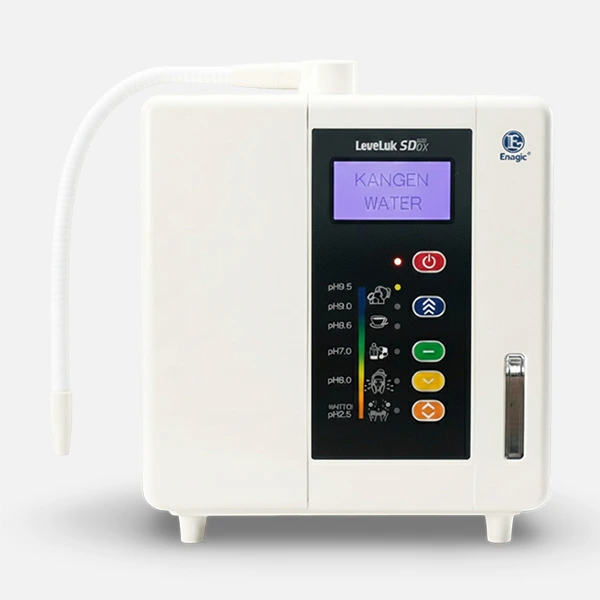
The SD501DX is positioned as the regular residential choice.
It is particularly well suited to families who want a more capable residential machine with a higher electrode count and stronger listed specifications.
The SD501DX offers:
- 7 titanium electrode plates
- Approximately -631 mV listed negative ORP
- 4.5–7.6 L/min listed Kangen Water production
- Simple physical buttons
- LCD display
- Voice guidance in 8 languages
- Universal power input
- Five types of water
- Fully automatic operation
- 5-year warranty
For a regular family household, the SD501DX is generally the more suitable choice between these two models.
It provides a more complete standard residential configuration while also offering greater flexibility for international buyers.
Why Choose the JRIV?
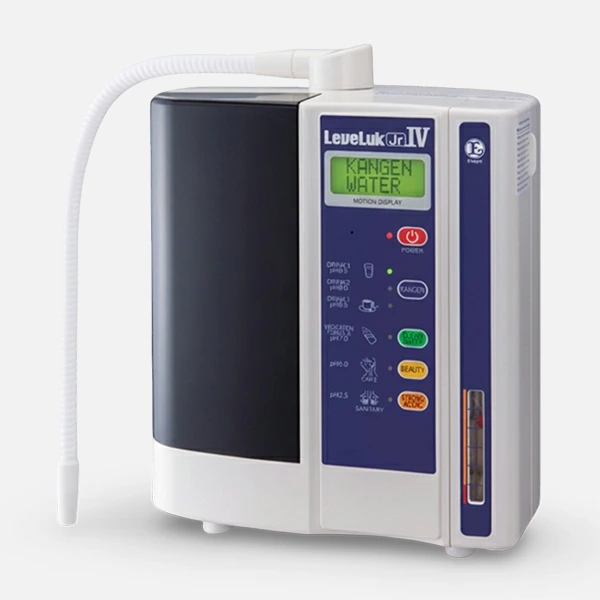
The JRIV is positioned as a budget-oriented residential Kangen Water machine.
It can be particularly attractive to:
- Single-person households
- Couples
- Buyers who are more budget-conscious
- Buyers with moderate daily water needs
- Buyers who do not specifically need voice guidance
- Buyers who are comfortable purchasing the appropriate country-specific voltage configuration
The JRIV offers:
- 4 electrode plates
- Approximately -450 mV listed negative ORP
- 3.0–4.9 L/min listed Kangen Water production
- Fully automatic operation
- Simple operation
- Five types of water
- 3-year warranty
The JRIV is therefore a sensible option for buyers whose priorities are affordability, moderate usage, and a simpler residential configuration.
Which One Is Better for a Family?
For a regular family, the SD501DX is generally the better fit.
A family is more likely to benefit from the SD501DX's:
- 7 electrode plates
- Higher listed Kangen Water production
- More negative listed ORP
- Voice guidance
- 5-year warranty
- Universal power input
The JRIV can also serve a family household, but its positioning makes more sense when the buyer's priorities are primarily lower initial cost and moderate household use.
If several people will be using the machine regularly throughout the day, the SD501DX is the model I would generally favor between these two.
Which One Is Better for a Single Person or Couple?
For a single person or couple, the decision is more balanced.
The JRIV can make sense if:
- Keeping the initial purchase cost lower is important
- Daily water demand is moderate
- Four plates are sufficient for your needs
- Voice guidance is not important
- You are comfortable with the appropriate country-specific voltage configuration
The SD501DX may still be preferable if you want:
- 7 electrode plates
- More negative listed ORP
- Higher listed production rates
- Voice guidance
- Universal power input
- A longer warranty
So even for a single person or couple, the JRIV is not automatically the better choice. It is primarily the budget-oriented choice.
SD501DX vs JRIV: Quick Decision Guide
If Your Priority Is... | Better Fit |
|---|---|
Regular family use | SD501DX |
Standard residential choice | SD501DX |
Budget-oriented residential option | JRIV |
Single person or couple | JRIV may be suitable |
7 electrode plates | SD501DX |
4 electrode plates | JRIV |
More negative listed ORP | SD501DX |
Approx. -631 mV listed ORP | SD501DX |
Approx. -450 mV listed ORP | JRIV |
Higher listed Kangen Water production | SD501DX |
Voice guidance | SD501DX |
Universal power input | SD501DX |
Country-specific voltage configuration | JRIV |
5-year warranty | SD501DX |
3-year warranty | JRIV |
Fully automatic operation | Both |
Five types of water | Both |
Size and Weight
The two machines have the same listed dimensions:
264 × 338 × 171 mm
However, their listed weights are different.
SD501DX
5.4 kg
JRIV
6.3 kg
Model | Dimensions (W × H × D) | Weight |
|---|---|---|
SD501DX | 264 × 338 × 171 mm | 5.4 kg |
JRIV | 264 × 338 × 171 mm | 6.3 kg |
The JRIV is therefore not significantly smaller in physical dimensions than the SD501DX.
If you are considering the JRIV because you expect it to take substantially less counter space, the dimensions are actually the same based on the listed specifications.
The main differences between these models are their configuration, features, specifications, and positioning, rather than their physical footprint.
Power and Warranty
The SD501DX has a listed power rating of 230 W, while the JRIV is listed at 120 W.
Feature | SD501DX | JRIV |
|---|---|---|
Power | 230 W | 120 W |
Warranty | 5 years | 3 years |
The SD501DX also has a longer listed warranty period.
The power rating should not by itself be interpreted as a direct measure of water quality or overall machine performance. It is simply one of the technical differences between the two models.
Detailed Technical Specifications
For buyers who want to review the technical details, the following table provides a complete side-by-side comparison.
Specification | LeveLuk SD501DX | LeveLuk JRIV |
|---|---|---|
Positioning | Regular Residential | Budget-Oriented Residential |
Electrode Plates | 7 | 4 |
Plate Size | 135 × 75 mm | 135 × 75 mm |
Listed Negative ORP | -631 mV* | -450 mV* |
pH Range | 2.5–11.5 | 2.5–11.5 |
Water Types | 5 | 5 |
Power Input | Universal Power Input | Country/Market-Specific |
Power | 230 W | 120 W |
Total Weight | 5.4 kg | 6.3 kg |
Dimensions (W × H × D) | 264 × 338 × 171 mm | 264 × 338 × 171 mm |
Kangen Water Production | 4.5–7.6 L/min | 3.0–4.9 L/min |
Acidic Water Production | 1.5–2.6 L/min | 0.2–1.9 L/min |
Strong Acidic Water Production | 0.6–1.1 L/min | 0.3–0.7 L/min |
Operation | Fully Automatic | Fully Automatic |
Interface | Physical Buttons + Larger LCD Display | Physical Buttons + Smaller LCD Display |
Voice Guidance | Yes — 8 Languages | No |
Warranty | 5 Years | 3 Years |
*ORP values are listed specifications under specified conditions. Actual ORP can vary depending on water quality, incoming water conditions, and flow rate.
SD501DX or JRIV: Which Should You Choose?
Choose the SD501DX if you want a residential Kangen Water machine for regular family use and value a higher electrode count, more negative listed ORP, higher listed production rates, voice guidance, a longer warranty, and universal power input.
Choose the JRIV if you are primarily looking for a budget-oriented residential option, particularly as a single person or couple with moderate daily water needs.
The simplest way to remember the difference is:
SD501DX = Regular Residential + Family Use + 7 Plates + Approx. -631 mV Listed ORP + Universal Power Input
JRIV = Budget-Oriented Residential + Singles/Couples + 4 Plates + Approx. -450 mV Listed ORP
For a regular family, the SD501DX is generally the more suitable choice.
For a single person or couple who places a higher priority on keeping the initial purchase cost lower, the JRIV can be a sensible alternative.
Final Comparison
The SD501DX and JRIV are both residential Kangen Water machines, but they are designed around different buyer priorities.
The SD501DX is the regular residential choice. Its 7 electrode plates, approximately -631 mV listed negative ORP, higher listed production rates, voice guidance, universal power input, and five-year warranty make it particularly well suited to regular family use.
The JRIV is the budget-oriented residential choice. Its 4-plate configuration, approximately -450 mV listed negative ORP, lower listed production rates, simpler operation, country-specific voltage configuration, and three-year warranty make it particularly suitable for singles, couples, and buyers who are more conscious of the initial purchase cost.
For a regular family, the SD501DX is generally the better fit.
For a single person or couple who is particularly budget-conscious, the JRIV can be a reasonable alternative.
The choice ultimately depends on whether your priority is a more complete standard residential configuration or a simpler, more budget-oriented option.
Explore Other Model Comparisons
If you are still comparing Kangen Water machines, explore the other comparison guides on this website:
SD501DX vs K8 — Compare the regular residential SD501DX with the premium residential K8.
SD501DX vs SD501U — Compare the countertop SD501DX with the under-counter SD501U configuration.
Super501 vs Home Models — Understand how the Super501 compares with residential Kangen Water machines.
Full Comparison — Compare the current Kangen Water machines side by side.
Need Help Choosing a Model?
If you have compared the available Kangen Water machine models and are still unsure which one fits your needs, contact us for purchasing guidance.
We can help you review your intended use, household needs, installation preferences, and the differences between the available models.
